|
 |
|
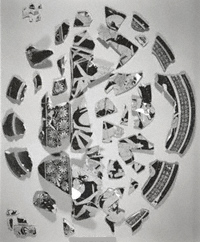
Approximately one third of an unusually large krater (mixing vessel) in the collection of the J. Paul Getty Museum at the Getty Villa survives as a collection of fragments. Getty conservators constructed a full-scale facsimile of the vase form on a turntable and then inserted the fragments into the facsimile.
Creating the Facsimile
The contours of the vessel's existing fragments were measured with instruments such as gauges and calipers to develop accurate drawings of the vase's interior and exterior profiles, which were transferred to templates for the turntable.
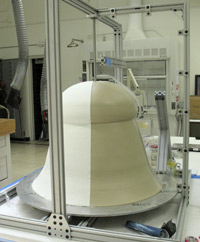
The template of the inner vase profile was then used to turn a large foam and synthetic clay volume representing the internal, empty space of the ancient vessel. The synthetic clay was covered with a plaster-like paste, forming the inner surface of the reproduced vase.
|
 |
The krater in fragments, at the beginning of the project
|
 |
The facsimile of the vase form in progress on a turntable in the Antiquities Conservation studios at the Getty Villa
|
|
 |
|
Next, the template of the outer profile was attached to the turntable, and synthetic resin was applied over the inner layer. The circular platform was again rotated, this time to form the walls of the vessel.
Finally, the outer template was moved slightly outward, and a plaster-like paste was applied to the synthetic resin as the platform was turned. This created the outer surface of the vase.
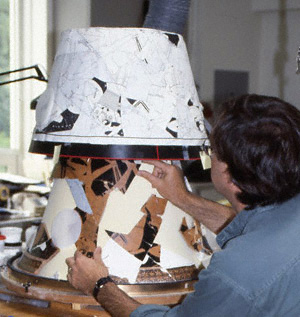
After constructing the model, holes were cut out to receive the original fragments, which were fastened in place using a reversible adhesive.
|
 |
|
Placing Fragments
Tracings of the original fragments were cut out and positioned on a paper form. Missing areas were then drawn in and refined with the collaboration of scholars, providing a reference model for reconstruction.
A study of parallels—other vases with a similar shape or painted figural scene—also provided clues to fragment locations and the original design.
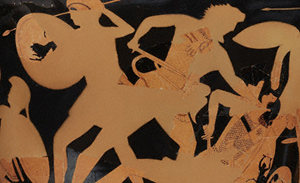
The principal side of the vase depicts the hero Herakles conquering an Amazon enemy. The locations of the fragments were determined from several factors. The hero's pose and elements of his costume link the floating, or non-joining, Herakles fragment in close proximity to the fallen Amazon to the right.
In another instance, an Amazon archer's uniform provided clues for fragment placement. At times, only the directionality of spears or the thickness of the ceramic helped conservators position the pieces.
|
 |
Conservator Jeff Maish places the fragments into the clay facsimile using the paper form with tracings of the original fragments as a guide.
|
 |
|
Restoring Painting
The approach to the restoration of this vessel aimed not only to reconstruct its shape but also to clarify the painted narrative. Generalized terracotta-colored silhouettes with no added detail were painted in to provide a visual context for the isolated fragments.
The battle scene now comes to life, as 13 Greek and Amazon warriors face off in striking poses that form a series of triangular compositions around the vase.
|
 |
Terracotta-colored silhouettes were painted in to help clarify the figural scene. In this section of the vase, the hero Herakles vanquishes an Amazon warrior.
|
 |
|
|
All images on this page: Restored Mixing Vessel with Greeks Battling Amazons, attributed to the Syleus Painter, Greek, Athens, 480–470 B.C., terracotta, 25 3/8 in. high x 27 1/8 in. diam. The J. Paul Getty Museum, 81.AE.219
|
|
 |